

- A Dangerous Invitation
- Secrets in Scarlet
- Beauty and the Rake
- Stealing the Rogue’s Heart

HIS BUSINESS IS DISCOVERING SECRETS
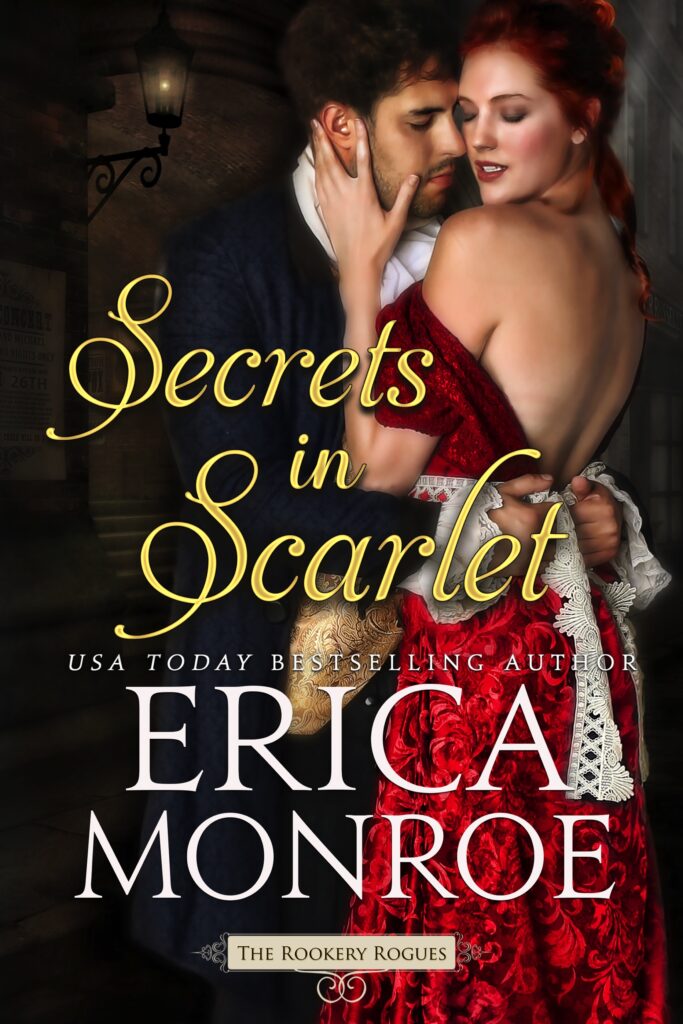
When a girl is murdered at a factory in London, Sergeant Thaddeus Knight of the Metropolitan Police comes in to investigate. But it's not just the factory owners that Thaddeus wants information on-the devilishly intriguing Poppy O'Reilly is a puzzle he'd like nothing more than to solve.
HER LIFE DEPENDS ON KEEPING HER PAST HIDDEN
All it took was one scandal for Poppy to lose her reputation. Shunned by polite society, she's retreated to the one place no one from her old life would look for her: the rookeries. Protecting her young daughter is the most important thing to Poppy, and Thaddeus threatens the false identity she's carefully constructed. The last thing she should do is allow Thaddeus close to her family, yet she can't stay away from him.
With danger around the corner, will the secrets of a scarlet woman lead to their undoing?
----
Note: Secrets in Scarlet is a dark, gritty, and steamy (on page sex scenes) full-length romantic suspense featuring the pre-Victorian working class, set in the London underworld. While it is book two in the Rookery Rogues series, it can be read as a stand-alone historical romance.
Chapter 1
“YOU’RE MEANT FOR great things, my boy.” Leaning back in his claw-footed chair, Inspector Jonah Whiting smoked a cheroot and regarded Thaddeus with barely veiled impatience. “That business with the resurrectionist’s ring was the luckiest break you’re liable to get in this business.”
Three months prior, Thaddeus had apprehended Jasper Finn in a workhouse cemetery in East Smithfield. While the arrest had led to the captures of most of Finn’s grave robbing ring, the real bounty had been in tying Finn to several other unsolved murders in London.
Whiting wouldn’t let Thaddeus forget this grand success for the rest of his whole damn life.
The inspector smiled one of those simpering smirks meant to ingratiate Thaddeus to him. “Superintendent Bicknell has taken notice. If you play your cards right, you too could have one of these offices. Inspector Doughty is set to retire in a month.”
READ MORE“Aye, it’d be an honor to be considered, sir.” Nervousness quivered in his stomach at thought of taking Doughty’s place. To be an Inspector at twenty-four years of age was unheard of in the Met, but Thaddeus had worked harder than anyone else on their route. Certainly harder than the other contender for the job, Michael Strickland.
As an inspector, Thaddeus would be able to make a real difference in the Spitalfields rookery. But he wasn’t sure he was willing to give up investigating cases like Anna Moseley’s for a chance at a loftier position. The trail of Miss Stewart’s murder was long cold, but he could find out who had killed Miss Moseley. Her family deserved answers.
“If you’d stop insisting upon investigating cases like this one...” Whiting scooped up the folder, dropping it unceremoniously back down. The papers scattered every which way, lost in the sea of Whiting’s untidy desk.
Thaddeus grimaced, and then promptly tried to hide that grimace with a not-so-well-placed cough. Whiting’s brassy glance fixed upon him.
“Sir, if you’d take a moment and look through the papers...” Thaddeus resisted the urge to grab the file and start rearranging it. It had taken him three hours to put together that file for Whiting, and now it would take him three more hours to put it back into proper order.
Whiting snorted, resembling more of a pig than a commanding officer. He had an up-turned long nose, short ears, and copper eyes the color of clock gears. At fifty years of age, he’d been a member of the old Watch until the Met was formed. Whiting never hesitated to inform his officers—mostly, Thaddeus—of what working with the Met meant.
“It’s a simple case of rookery violence, Knight,” Whiting said. “We’re Peel’s men and Peel’s men don’t spend their time on this rigmarole. We prevent crimes from happening in the first place.”
Their work was noble. Triumphant, even. They were a solution before there was ever a problem. Of course, a certain leniency could be granted. Arrests had to be made, and thus, cases had to be looked into when the culprit wasn’t found on the scene. The Bow Street Runners wanted little to do with the East End.
“Investigating the deaths of every lowdown bunter who crosses your path will get you nowhere,” Whiting lectured. “You’ve got a quick mind, Knight, and the boys in Westminster like you.”
Thaddeus shifted in his chair. “Sir, the logic is sound here. If you’d just give me some time, I think I’ll find out that the Larkers are involved in far more.”
If Whiting didn’t assign Thaddeus leave to investigate the Moseley death, he’d have no other recourse. Whiting was his superior by assignment. If Thaddeus went over Whiting’s head, he could say goodbye to the inspector job. And Whiting would make damn sure he didn’t have a job to come back to, prior brilliant arrest of Jasper Finn or not.
Whiting’s cheroot dangled from his fingers, above the file. “Apparently, you helped out some countess?”
“Sir, if you’d be a bit more careful with that file…” Thaddeus began, biting back a groan as Whiting blinked at him.
Whiting set down the loosely rolled cheroot. It spilled upon impact, the uncut ends leaving foul traces all over the parchment. There’d be no hope of reading the paperwork again.
Why, oh, why did people treat his efforts at organization with such blatant disregard? Thaddeus would never understand this. Order brought the needed clarity to discover solutions in the most disjointed of fragments. What was so wrong with a little clarity?
“Tell me about this countess,” Whiting demanded, ignoring Thaddeus’s pained stare at the cheroot.
“I found the countess’ jewels for her,” Thaddeus explicated. “My brother brought the case to my attention. The countess was one of his client’s at Barclay’s.”
That had been a slow week. Any more cases like that one, and his brains might dribble out of his ears from boredom.
“That is the type of outside work you take, my boy,” Whiting praised. “You ought to be doing your route, not sitting across from your superior whining about why you can’t investigate a random whore’s murder.”
Thaddeus was most assuredly not whining. “If you had seen her—”
“I would be saying the exact same thing.”
“She died in my arms.” Thaddeus couldn’t shake the memory of her once-warm flesh against his blue coat. “She couldn’t have been more than fourteen. A young girl.”
“Terrible incident,” Whiting hedged. “But it’s Spitalfields and it’s to be expected. Those weavers are a sordid sort, turning to brew and promiscuity to while away the hours between shifts at the factory. She was probably beaten by some bullyback.”
“This was more than some brothel scuttle,” Thaddeus insisted.
Murder was foul in all forms, no matter who had been murdered. Wasn’t it their job to stop it? They were supposed to protect these people.
Whiting wouldn’t understand. He was not a sentimental man. But Whiting might grasp hard facts, so Thaddeus led with that.
“Miss Moseley said we couldn’t protect her. That ‘they’ have people working for them we don’t know about. I think it’s the Larkers, sir. They own the factory where she was found. When she died, her fingers were sketching the letter ‘L.’”
“It’s not enough to go on,” Whiting said. “Besides, the Larkers have never caused trouble before. Boz Larker is a respected man of business. If you falsely accuse him, you’ll have a lot of explaining to do.”
“I can get more information,” Thaddeus insisted. “I’ve compiled a list of everyone the Larkers have associations with.”
In the file that Whiting’s cheroot had destroyed. Damnation.
“Considering most textile factories are moving to Manchester or Lancashire, dismissals should have happened in spades. It’s not a union factory. There’s nothing stopping them from dismissing,” Thaddeus said. “Still, they retain a full staff of thirty weavers, most working at Jacquard looms.”
“The French looms, as if it wasn’t enough the Frog tried to invade our country.” Whiting sniffed. “How quickly people forget these things when money is to be involved.”
How quickly we forget the idea of justice when money is to be involved, Thaddeus should have said. Instead, Thaddeus stared blankly at Whiting, who held in his stupid, bloated hands the fate of far too many poor men and women in this district.
Whiting was a cancer, eating away at a system that had been meant to instill faith. Every day, Thaddeus saw people shivering in the doorways of their rundown tenement houses, barefoot and desperate in the streets, drunk off the penny drams sold in the gin palaces.
Those people had no one else to fight for them, and Thaddeus would rather be damned than give up on them. If that made him foolish and egotistical, so be it.
“That money’s coming from somewhere,” Thaddeus insisted.
Whiting let out a much-harassed sigh. “The Larkers have money, Knight. Maybe he’s funding the factory from his pocket.”
“You know as well as I do that people don’t run factories because they care for the workers. If there’s no profit, why is the factory still in business?” Thaddeus asked. “I want this case. I’ll work it in addition to my regular shifts. I’ll take those meetings you wanted me to with Superintendent Thomas. I’ll tell him it was your planning that set me up to get Trigger Jem.”
A calculating gleam shined in Whiting’s eyes. “If you’re willing to speak to Thomas, then I think we can get the younger Strickland to look into your route.”
Thaddeus winced. Michael Strickland was not only his competition for the inspector spot, but he was a rash imbecile. Strickland’s lone good trait was that he was less of an ass than his father—Claudius Strickland had arrested Daniel O’Reilly three years ago for a murder Jasper Finn had committed.
Finn couldn’t hurt anyone again. He’d hung in a widely attended execution that hearkened back to the days of Tyburn.
Yet there were still villains out there. If Strickland was what he had to endure to find Miss Moseley’s murderers, then Thaddeus would deal with Strickland.
He nodded.
“Very good,” Whiting agreed. “Two weeks.”
“That’s not enough time.” Thaddeus pointed to the beleaguered file on Whiting’s desk. “I believe there’s more at stake here than the girl’s death. I outlined some of my conclusions—”
“Fourteen days,” Whiting stated firmly. “Fourteen days and then you’re done. No more of this nonsense. You’ll do as I tell you, Knight, or so help me God, I’ll have you removed, genius or not.”
Fourteen days. A day for every year of the girl’s too-short life.
***
The Larker Textile Factory was not anything special. It was like everything else in Spitalfields, once beautiful but now moldering. The majority of the factory workers had seen their fortunes dwindle, as new machinery and the repeal of the weaving acts outlawing foreign imports made the hand loom weavers irrelevant.
Poppaea “Poppy” O’Reilly was neither Protestant nor French; nevertheless she felt a kinship with the Huguenot weavers. Like them, she had come to London expecting to find sanctuary. An escape from her wicked past.
This April evening, a bell tolled portentously throughout the factory. Poppy glanced over toward the clock hanging on the wall. It was a quarter past five—there was no way the closing bell should have been ringing. The Larkers cared little for the diatribes of reformers. If they could force their workers to stay after the designated twelve-hour shift, they would.
“Come along, before they change their minds!” Abigail Vautille cried, skidding by. Her light blue dress was creased from where she’d been sitting at a loom all day, dust lining the hem, but no amount of dirt and grime could take away from Abigail’s beauty.
At nineteen, Abigail was the same age as Poppy. With almond-shaped blue eyes and a small nose, Abigail was everything that was fresh-faced and innocent.
Poppy was used and tarnished.
Abigail’s younger sister, Bess, trailed behind her. Bess offered her hand to Poppy shyly, a dingy ginger curl falling across her eye. Beige, ocher, and blue threads tangled with her unruly hair. Children as young as six quilled silk until their small hands were blistered and bleeding.
Leading Bess by the hand, Poppy kept walking through the factory. Abigail followed behind them.
“Why do you think they’re letting us go so early?” Abigail asked, careful to keep her voice low lest the Larkers overhear her.
Boz Larker’s office door was closed. It’d been closed since four that afternoon, though little sound carried from the office when the looms were in motion. Larker closed the door when he didn’t want the workers to know who was visiting him.
Poppy nibbled on her bottom lip. “I don’t know.”
Bess peeked up at her. One look at Bess was enough to convince Poppy that she was doing the right thing. She might not be able to save Bess from a hard life, but devil take it, she’d sell her body before she allowed her own daughter to work in one of these factories. Every shift brought money home to support Moira.
“Let’s not question their generosity, shall we?” Poppy quickened her pace, and Bess trotted after her.
Abigail nodded, lifting her skirts up so that she’d not trip on them as she walked. Though Poppy was shorter than her, Abigail’s strides were never regular. As a child, Abigail had worked as a piecer, sliding underneath the machinery and resting on her right side to mend the broken threads. Her right knee bent inward, giving her an awkward, almost waddling walk, but if she was careful, she could move at an almost parallel speed to Poppy.
They fell into step with the rest of the workers. What had once been an orderly line at the first toll of the bell had quickly descended into a mob. No one wanted to be present should the Larkers change their minds about the early exodus. Poppy kept one hand on her lantern and the other on Bess, shielding her as people pushed to and fro in their attempts to fit through the slim doorway. Abigail stumbled as a man slammed into her, but caught herself on an iron stand used to hold gingham bags, scrapers, and netting.
Finally, it was their turn to leave.
Cool, crisp air washed over Poppy’s face as they stepped outside. She let out a deep breath, readjusting to the new smells of the outdoors. The factory was all iron and rust, silk and fibers, but here in the open the scents varied. Down the street someone was baking bread, while the odor of juniper lay finely over everything from the several open dram palaces.
She could place gin within a five-meter radius, thanks to her brother, Daniel.
The first traces of nightfall had descended over Spitalfields. Poppy stopped for a moment to allow Abigail to catch her breath, and lit the lantern with a lucifer match. She leaned back against the wall. As soon as the crumbling brick side met with the thin cotton of her dress, she sprung forward as if stung.
Not more than a week ago, Anna Moseley had been found against this wall, beaten and stabbed. Some fool Peeler had lifted her up from the spot, probably worsening her injuries.
The Met didn’t give a whit about Anna’s death. They hadn’t cared when they arrested Daniel for a murder he didn’t commit. He’d been in the wrong place at the wrong time, a victim of circumstances. The bloody Peelers didn’t care about victims.
But Poppy cared, damn it, and Anna had been a good person. A sweet girl with her whole life ahead of her.
“I miss her too,” Abigail remarked.
Poppy sighed. “It isn’t fair.”
Bess blinked. She looked from Poppy to her sister and back again, her brows furrowing with consternation.
Pulling Bess to her, Abigail covered the girl’s ears with her hands. “There’s no sign that the Larkers had anything to do with Anna’s murder,” she whispered.
“And no sign that they didn’t,” Poppy murmured.
“You could go somewhere else,” Abigail suggested, unclasping Bess’ ears. “The way you fix up the clothes you find in the rag and bone shops...I’d be lucky to ever be half as good, and I’ve been at this my whole life. You could easily make twice as much in the pretty shops on Bond Street.”
“No.” Poppy shook her head. She didn’t tell Abigail she’d worked as a dressmaker’s assistant until she’d been dismissed from that post. She didn’t tell Abigail anything that remotely resembled the truth because she knew better.
Some lies had to be upheld.
“Besides, what would you do without me?” Poppy forced a grin. Abigail meant well.
“Oh, I’d moan and groan, but I’d muddle through,” Abigail smiled back.
They continued walking. The street was empty. It was too early for the gin crowd. The rest of Spitalfields was either at work in another one of the factories, sitting down to supper with their family, or sleeping off last night’s bout.
“What are you going to do with the extra blunt you earned from weaving the most silk in a week?” Abigail asked.
“I haven’t thought about it.” Another lie, for Poppy knew exactly what she’d do with the bonus: it would go in the fund for Moira to attend a finishing school someday.
“You must have a plan,” Abigail teased. “I’d buy more books, of course. I finished The Italian last night. Thank you for loaning it to me.”
“You’re welcome.” Poppy smoothed her skirt with aching fingers, tingling from too many hours spent at the loom. “I suppose Moira would like some fruit.”
“Fruit?” Abigail repeated, her button nose wrinkling. “Ack. You’re so practical. I long for adventure, something scandalous.”Poppy had been scandalous once, and she’d paid the price.
“Eventually, of course, I’d like to marry,” Abigail continued. “It seems lovely to be married.”
“It was lovely,” Poppy lied. Wincing, Abigail reached for Poppy’s hand, covering it with her own. “I’m sorry, love, how insensitive of me. Rambling on about my problems, when the loss of your Robert is still fresh with you.”
Abigail’s soft blue eyes shone with sympathy for the supposed demise of a man she thought had meant the world to Poppy. If Abigail knew that the picture of her supposed husband Poppy carried with her had been purchased at a pawn shop, would she still feel such pains of sadness for her friend? Unlikely. So the fictional Lieutenant Robert Corrigan, of His Majesty’s Royal Navy, must remain Moira’s purported father.
Abigail stopped in front of a public house on Wheeler Street. In a few hours, this area would be alive with music, scoundrels, and the fancy crowd back from the most recent mill. She held the door open for Bess. The little girl darted inside, waiting by the bar for Abigail to enter.
Abigail turned back to Poppy. “Join us? After I drop off Bess back home, I’m going to the Ten Bells. I heard there’s a band tonight.”
“Afraid not.” Poppy shook her head. “Must be getting back to Moira.” The last rays from the sun were disappearing quickly. She’d have an hour or two after Moira ate dinner before the babe needed to sleep.
“See you tomorrow,” Abigail called.
Poppy moved away from the public house, eager to get home. Daniel and his wife, Kate, had agreed to watch Moira. Poppy’s companion, Edna Daubenmire, was out running errands.
The lamps faded at this point, giving way to the barely-lit crevices of back alleys and battered-window tenement houses. Staying close to the public houses would give her enough light to see by on her way home, provided she didn’t dally any longer. She had memorized which roads she should avoid at what times, taking a different way out in the morning than she did when returning in the evening. Poppy carried a knife and a pair of scissors in her apron pocket, just in case.
She set off, her pace swift and determined.
Footsteps echoed behind her.
She spun around to confront the person, lantern high in her grasp. In the shadows, the tall, lanky build of the man was visible, a square hat atop his head.
“Wot ye want?” she snapped, dropping her voice into the cutting dialect of the East End like Kate had taught her.
The man came closer, the lamp’s glow hitting him. Clothed in a blue uniform, a regulation truncheon at his side, that damn hat—he was a Peeler, if she ever saw one.
Bollocks and the balls that came with them.
Poppy had three core beliefs: protect family, be loyal, and avoid officers of the law at all costs.
“Scurry on now, guv, I don’t be wantin’ your type,” she commanded, gesturing toward the other end of the street. “Ain’t nothin’ ’ere for ye to see.”
The man’s eyes narrowed, and all too quickly Poppy realized she’d overplayed her hand. He’d think her a whore, angling for paying bedfellows.
She shook her head quickly, a stray red curl slipping free from underneath her cap at the franticness of the motion. “Oy, I got a family to tend to, and I ain’t done nothin’ wrong.”
“Steady, Miss,” he cautioned, one brow quirking with amusement.
He thought her amusing. The wretched man, accosting her on the street.
She steeled herself, gripping the lantern tightly. “Mrs.”
He nodded stiffly. “My apologies.”
She sniffed. Let him believe she had a man at home to protect her, if it meant he’d leave her alone faster. While she’d delivered a stirring performance of guttersnipe worthy of Covent Garden, there was a flash in the officer’s eyes that left her distinctly unsettled.
As if he knew something about her that he shouldn’t.
“You came from the factory,” he stated. His voice was smooth, baritone, striking at something within her that shouldn’t have resonated.
“So wot if I did?” She didn’t have to feign the agitation in her voice. Her free hand fell to her hip. “Is that a crime now, guv? I’m an ’onest one.”
She had been honest, once.
“I doubt that,” the man replied. “But I’m unconcerned about your true vocation. I care more about the girl who was murdered at the Larker factory last week.”
Anna. Poppy swallowed down her discomfort. An investigation into Anna’s death was highly unlikely. No piggish Peeler cared for a simple fourteen-year-old girl who couldn’t read or write. He must have another reason for stopping her, and it couldn’t be a good one.
Poppy’s stomach tightened. He’d want to know more about her. Atlas had given her a false history strong enough to hold up to casual observance, but under careful examination...
She couldn’t risk this Peeler finding out and revealing Moira’s true parentage.
“I don’t know anythin’ about that, and even if I did, I wouldn’t be tellin’ ye,” Poppy declared. “Go on yer merry way, ye bleedin’ blighter. My babe calls.”
COLLAPSEEve Polak on RT Book Reviews wrote:Riveting story, superb characters, stellar prose: a remarkable book! Monroe is a supremely gifted writer: her prose is flawless, fluid and elegant; her vocabulary choices are impeccable and suited to the characters; she possesses a perfect understanding of the class differences and customs of the era. The relationship between Thaddeus and Poppy is beautiful and realistic; their love story took my breath away. The plot is intricate, exciting, and comes to a logical and rather shocking conclusion. Secrets in Scarlet is a fabulous book that no one should miss!
on Romantic Historical Reviews:This book is perfect for the historical enthusiast who is tired of the same old historical romance. While most historicals focus on the grandeur and drama of the season and the ton, this story takes a different and unexpected approach. It has a rich setting, a lot of suspense and a gritty rawness that makes it emotional and beautiful.
Secrets in Scarlet is a story that readers can fall in love with instantly. [The book has] a romantic historical hero in every sense of the label. Knight makes audiences believe in the goodness of human nature.
Read the Author's Note to Secrets in Scarlet
Letter to Readers
Dear Reader,
Trivia
- Erica was inspired to create Poppy after reading several stories in Henry Mayhew's London and the Laboring Poor. Because a woman's virtue was basically her entire reputation in romantic era England, Poppy's mistake of giving her virginity up to a blackguard who abandons her afterwards seals her fate as a "fallen" woman in the eyes of society. When it is clear that the child she has conceived is illegitimate, her small town in Dorking, Surrey, rises up against her. Poppy seeks sanctuary in London with her brother, Daniel (hero of A Dangerous Invitation).
- In writing Secrets in Scarlet, Erica also wanted to take a look at the modern day philosophy of "slut shaming," or condemning a woman for her sexual past. Poppy must learn to trust herself again and that her desires are nothing to be ashamed of.
- The Magdalen asylums that Poppy fears are taken straight from history. Ireland's asylums were particularly fearsome, and still existed well into the 20th century. Originally started to "reform" prostitutes, the Magdalen asylums eventually became homes to single mothers, fallen women from other circumstances, women unable to afford housing otherwise, women from tarnished pasts, and so on. Women in the asylums wore a bland uniform and were expected to do laundry as payment for their board. They received little to no other compensation.
- Thaddeus Knight originated from a character Erica used to play in a text-based RPG. This is the fifth and final version of his story.
- There were many inspirations for Thaddeus--Chuck Bartowski from the TV show Chuck, Sherlock Holmes, and every nerdy, awkward man Erica has known and loved.
- Thaddeus is the second son of a second son of an Earl, which gives him absolutely no title or money, but it is a point his mother likes to trot out at dinner parties.
- Erica did a lot of research into Jacquard looms and weaving to give an authentic feel to Poppy and Abigail's work in the Spitalfields factory. Erica also researched factory conditions and maladies of the workers.
- The Larker factory is set on White Lion Street, where there was actually a factory marked in an 1880 map of Spitalfields. While Erica couldn't find any indication that a factory had been there in 1832, it was an interesting bit of history to pay homage to. England was still experiencing the effects of the Industrial Revolution at this time.